DKCC V-Twin Customs — Personal Build
Thor
117 RWHP on a bone-stock Evo Softail frame. Doug's personal machine — named for his Norwegian Viking heritage, and featured on the cover of American Iron Magazine.
117
Rear Wheel HP
111 ft-lb
Rear Wheel TQ
Jim's 6-Speed
Transmission
American Iron — May 2000
Magazine Cover
Named for a Viking
Thor was Doug Keim's personal bike — purchased new from the local Harley-Davidson dealer and brought straight back to the shop. The name came from Doug's Norwegian Viking heritage. It fit. This machine had the kind of presence and power that earned it.
There's a bit of a story behind this bike — some craziness and nonsense along the way — but that's not what matters here. What matters is what Doug built, and what it proved.
The Premise
The goal was simple and ambitious at the same time: show what could be done with a stock-framed Evolution-powered Harley-Davidson Softail. Not a custom frame. Not a stretched chassis. The bone-stock Evo Softail frame that came from the factory — and build something extraordinary around it.
This was the mid-1990s. The things Doug was doing on this machine weren't common. They weren't even close to common. They were ahead of their time in ways that only became obvious years later when everyone else started doing them.
The Rolling Chassis
The wheels were 18" RC Components billet pieces — front and rear — with a Metzeler 130 up front and a 160 on the rear. Running a 160 rear tire on a stock Softail frame was a significant achievement in the mid-90s. It wasn't something people were doing. Doug made it work.
Braking was handled by a Performance Machine 13" rotor up front with a 6-piston caliper, and an 11.5" rotor out back with a 4-piston PM caliper. The stopping power matched the go.
The fork trees were a thick, custom-machined set of billet one-off trees — plus 2 degree — built specifically for this application. Front and rear suspension were both lowered 1.5". The front tubes received RaceTech springs and gold valves. The rear got custom springs to correct the factory's over-sprung setup and dial in the ride properly.
The swingarm was a Ness billet piece. The front fender was composite. The stretched steel tank was done in-house at Creative Cycles. The rear fender was assembled by combining several factory Harley-Davidson fenders — cut, shaped, and welded together to achieve the width and length Doug wanted. Keep in mind: this was 30 years ago, before stretched fenders became commonplace. Doug was doing it before it was a trend.
The Engine
The engine on Thor was a test piece — built specifically to find out how far an 82-inch Harley-Davidson Evo could be pushed while remaining a reliable daily rider. The answer turned out to be: pretty far.
The foundation was an 82" HD-cased Evo. From there: S&S Cycles flywheels, Axtell 30-degree pistons, a massive cam, and all the best valvetrain parts available — Jim's roller rockers, big ports, large valves. The heads were dual-plug. Every component was chosen for both performance and longevity.
The drivetrain was a 3" open belt drive backed by a Jim's 6-speed transmission. Out back, a Thunderheader exhaust pipe.
The result: 117 rear-wheel horsepower and 111 ft-lb of torque. And it didn't just make peak numbers — it made big torque right around 2,200 RPM and pulled hard all the way through. A stump puller. A great-running engine that Doug put serious miles on.
The Details That Made It
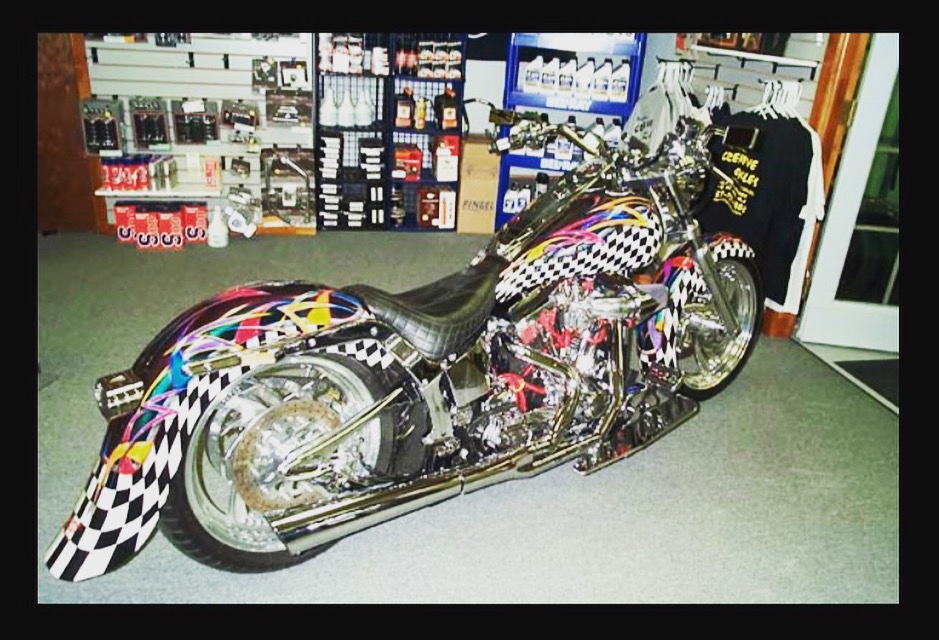
The seat deserves its own mention. The stitching was designed to match all the graphics in the paint work — a level of coordination between upholstery and paint that takes real planning and real skill. Richie knocked it out of the park.
And then there was the paint. Bill Clark from Creative Airbrush did the eyedropping paint on this machine. To see it in real life was something else entirely. The kind of work that stops people in their tracks.
How Far Ahead Was It?
Thor was featured on the cover of American Iron Magazine in May of 2000. That should answer the question.
It's a shame there are so few images of this bike left. But realizing it was put together 30 years ago, these things happen over time. What remains is the record of what it was — and what it proved was possible on a stock Evo Softail frame when the right builder got hold of it.
The Builder
Doug Keim
Creative Cycles — Umatilla, FL
- ▸1st Place — Hard Rock Casino National Build-Off
- ▸Artistry in Iron Las Vegas — Invitation-Only Invitee (2x)
- ▸People's Choice Award — National Televised Build-Off
- ▸IMBBA Hall of Fame Inductee
What Was Done
- ▸Bone-stock H-D Evo Softail frame
- ▸82" HD-cased Evo engine — dual plug heads
- ▸S&S Cycles flywheels
- ▸Axtell 30° pistons
- ▸Jim's roller rockers, big ports, large valves
- ▸Massive cam — full performance valvetrain
- ▸Jim's 6-speed transmission
- ▸3" open belt drive
- ▸Thunderheader exhaust
- ▸117 RWHP / 111 ft-lb TQ
- ▸18" RC Components billet wheels — front and rear
- ▸Metzeler 130 front / 160 rear tires
- ▸PM 13" rotor + 6-piston caliper (front)
- ▸PM 11.5" rotor + 4-piston caliper (rear)
- ▸Custom billet one-off fork trees — +2 degree
- ▸Front and rear suspension lowered 1.5"
- ▸RaceTech springs and gold valves (front)
- ▸Custom rear springs — corrected factory over-spring
- ▸Ness billet swingarm
- ▸Composite front fender
- ▸Stretched steel tank — built in-house
- ▸Custom rear fender — assembled from multiple HD fenders
- ▸Seat stitching matched to paint graphics — by Richie
- ▸Eyedropping paint — Bill Clark, Creative Airbrush
- ▸American Iron Magazine cover — May 2000
Photo Gallery
Thor — In the Photos That Remain
Few images survive from 30 years ago. These are what remain.