Commissioned Build — Doug Keim Creative Cycles
Doo-Wop
The Answer Was No
The first time the client asked Doug Keim to build him a trike, the answer was no. The second time, still no. It went on like that for several weeks — the client asking, Doug saying no, and the conversation ending there. Trikes weren't something Doug was interested in building. That was just the reality of it.
But somewhere in the back of his mind, the idea started to take shape. Doug began thinking about what it would actually take to build a trike worth building — not a bolt-on kit, not something that looked like an afterthought, but something genuinely cool. Something trick. Something that had never quite been done before. And he made himself a deal: if the client asked one more time, the answer would change.
He asked. Doug said yes.
The only condition was that it had to be something special. The client agreed without hesitation, and the two of them started laying it out — first in their heads, then on paper.
The Concept
The client was a man who loved doo-wop music and American Graffiti-era cars — the kind of machines you'd find at a sock hop or a drive-in on a Friday night in 1957. That world became the creative brief. The concept that emerged was a trike built in the spirit of those cars: no fenders. Clean. Low. Wide. The kind of machine that would have turned heads in any era, but felt unmistakably rooted in that particular moment in American culture.
From there, everything else followed naturally.
The Build
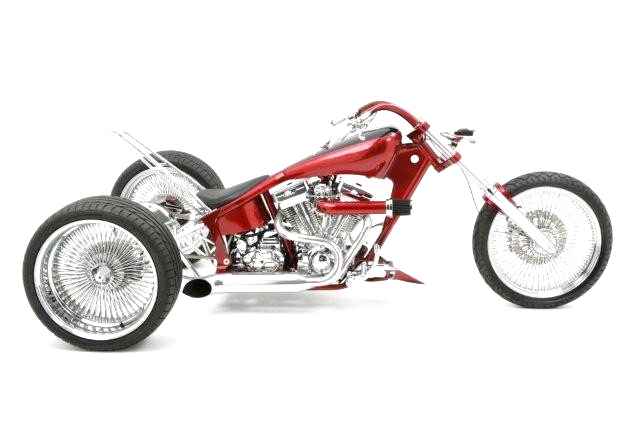
Doo-Wop is built on a DKCC ICON Pro Street frame — one of Creative Cycles' own. The ICON fuel tank and seat surround metalwork are DKCC originals. Doug hand-crafted the handlebars and fabricated a long tune intake to match the era and the attitude of the machine. The swingarm assembly was built in-house, and air ride was added to the rear to give the trike that low, planted stance that the concept demanded.
Up front sits a sweet 21-inch wheel. Out back, a pair of true knock-off 20-inch spoke wheels — the kind of detail that ties the whole American Graffiti theme together without ever being heavy-handed about it. No fenders front or rear. Just open wheel, clean lines, and the road.
Power comes from a polished TP Engineering 124-inch V-twin. The exhaust is a DKCC hand-crafted side-pipe design — the kind of pipes that would have been right at home on a '55 Chevy at the drive-in, and absolutely sock-hop approved. Open belt drive and a 6-speed transmission round out the drivetrain.
The Finish
The paint is the moment where Doo-Wop announces itself. Candy apple red on the panel tops transitions to gloss black on the sides, the two colors split by a baby blue pinstripe. It is time-appropriate, visually stunning, and exactly right for what this machine is. The color combination could have come straight off the show field at a 1958 custom car show — and it works just as well today.
The seat was hand-crafted by DKCC's own Costa Rican Richie — a stingray design that fits the era and the machine perfectly. The fit, the finish, the detail — it is all there, in every direction you look.
And Doo-Wop was not built to sit in a garage. This trike was used as a daily rider. That is the highest compliment a machine like this can receive — that it is beautiful enough to show and solid enough to ride every single day. That is the Creative Cycles standard, and Doo-Wop holds it completely.
What Was Done
- ▸DKCC ICON Pro Street frame
- ▸DKCC fuel tank & seat surround metalwork
- ▸Hand-crafted handlebars
- ▸Long tune intake — era-appropriate
- ▸In-house swingarm assembly
- ▸Air ride rear suspension
- ▸21" front wheel
- ▸True knock-off 20" spoke wheels rear — no fenders
- ▸Polished TP Engineering 124" V-twin
- ▸DKCC hand-crafted side-pipe exhaust
- ▸Open belt drive & 6-speed transmission
- ▸Candy apple red / gloss black paint — baby blue pinstripe
- ▸Stingray seat by DKCC Costa Rican Richie
The Builder
Doug Keim
Creative Cycles — Umatilla, FL — Est. 1977
- ▸IMBBA Hall of Fame Inductee
- ▸Hard Rock Casino Build-Off — 1st Place
- ▸Artistry in Iron Las Vegas — 2x Invitee
- ▸People's Choice Award — National Televised Build-Off
- ▸Celebrity builds for Pharrell Williams & Funk Master Flex
Photo Gallery
Click any photo to enlarge
Ready to Build Something Legendary?
If you have a vision — even one Doug might initially say no to — get in touch. The best builds start with a conversation.